
A step-by-step music session or workshop for children aged 4–10.
Keep in mind that you can make these activities easier or more challenging depending on the age group you are working with.
00:00–00:05 Introduction
We ask the children to sit in a circle. If they are already in the classroom, sitting on chairs, we keep them as they are.
If we’re meeting the children for the first time, we introduce ourselves and help them feel comfortable and at ease. We can do this by telling a joke or sharing a short story related to the moment or something happening that day.
00:05–00:15 Getting to know Rock & Roll
We ask them if they have ever heard the word “rock” and what it means. We can use the questions below:
- What does the word “rock” mean?
- What is Rock & Roll?
- Have you ever heard this genre of music?
- Can you say “We Will Rock You”? (If they are preschoolers.)
- Has anybody heard this song before?
00:15–00:30 Learning the Rhythm
We demonstrate the rhythm using our hands: two “BOOMS” by hitting our laps, followed by a “CLAP”.
BOOM – BOOM – CLAP
- BOOM – eighth note
- CLAP – quarter note
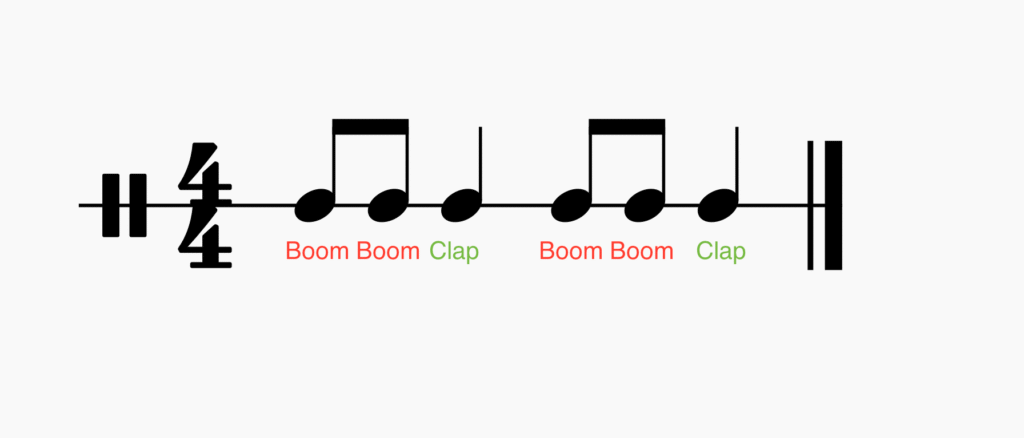
We practice the rhythm and help the children who find it difficult. Then, we try performing it without saying “BOOM BOOM CLAP”.
- We can ask the children to find words that rhyme with “CLAP” in the language we are teaching. This will help them stay focused and feel more involved in the activity.
For example, in English:
- BOOM BOOM TAP
- BOOM BOOM SNAP
- BOOM BOOM MAP
- BOOM BOOM NAP
The words can also have the same vowel sound in the middle but different ending consonants.
For example:
- BOOM BOOM HOP
- BOOM BOOM TOP
- ETC.
TWO GROUPS ACTIVITY
- We divide the children into two groups and ask each group to come up with a name for their team.
- One group performs the “BOOMS” (the eighth notes) and the other performs the “CLAP”, (the quarter notes) and then we switch roles.
- One group sings while the other performs the rhythm.
- We can also stomp our feet when performing the first two beats (BOOM BOOM).
- We can create different rhythmic patterns and challenges for the groups.
00:30–00:45 Movement Activity
We make a large circle or square on the floor using tape. If there isn’t enough space, we can use a hopscotch mat or agility rings.
We write the following words on the blackboard:
IN – OUT – SPIN – JUMP – FALL DOWN
You can also print the words on paper or display them using a projector.
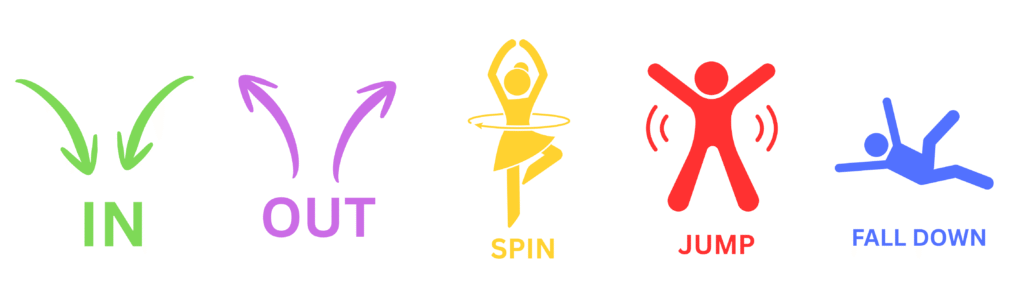
We play the instrumental version of “We Will Rock You” through a speaker.
Whenever the “CLAP” is heard, we point to one of the words written on the board, and the children have to perform the corresponding movement. If the rhythm feels too fast, you can slow it down or perform the movement after every two bars (after hearing ‘boom-boom-clap’ twice).
- If we point to “IN”, they have to step inside the ring, circle, or square.
- If we point to “OUT”, they have to step outside.
- If we point to “SPIN”, they have to turn around.
- If we point to “JUMP”, they have to jump.
- If we point to “FALL DOWN”, they have to jump. (Feel free to skip this if you’re not comfortable doing it in your current environment)
Why is this activity beneficial?
- Rhythmic awareness: Children learn to recognise, reproduce and maintain a steady beat.
- Coordination: Combining hand clapping, stomping and movement helps develop body coordination and motor skills.
- Listening skills: Children learn to listen carefully and respond to specific musical cues.
- Concentration: Following instructions and responding at the right moment encourages focus and attention.
- Creativity: Finding rhyming words and creating different rhythmic patterns allows children to experiment and express their ideas.
- Teamwork: Working in groups teaches children to cooperate, take turns and listen to one another.
- Musical expression: Exploring Rock & Roll introduces children to different musical styles and encourages them to experience music through rhythm, voice and movement.
- Confidence: Performing rhythms and movements in front of others helps children become more comfortable participating in group activities.
Follow us at @musicwithmserlete for more free sessions like this.


